Sep 10, 2026 Artificial Intelligence
AI in SaaS: How It Works, Key Benefits, and Its Applications
Sep 10, 2026 Artificial Intelligence

Table of Contents
Sep 10, 2026 Artificial Intelligence / Alcax
Software-as-a-Service (SaaS) has already become a default operating model for modern enterprises across industries. The reason is simple: it is replacing on-premises systems with scalable, subscription-based cloud applications. What next? Today, this SaaS transformation is entering a second, more disruptive phase driven by Artificial Intelligence (AI). This convergence of SaaS and AI is not simply enhancing existing software but also redefining how software is built, delivered, and consumed.
The scale of this AI shift is also reflected in market momentum. According to the Fortune Business Insights report, the global AI SaaS market was valued at approximately USD 22.21 billion in 2025 and is projected to reach USD 367.6 billion by 2034, growing at a CAGR of around 36.6%. This rapid expansion clearly indicates growing AI adoption and structural dependence of modern enterprises on AI-enabled software ecosystems. Worth mentioning, broader economic estimates also suggest AI could contribute up to $15.7 trillion to the global economy by 2030, driven by factors such as productivity gains, automation, and decision intelligence across industries.
In practice, AI is turning traditional SaaS tools into adaptive systems that learn from user behavior, automate decisions, and bring real-time personalization at scale. From customer engagement platforms to enterprise resource planning systems, AI is shifting SaaS from static workflows to intelligent, self-optimizing ecosystems. Understanding this evolution helps businesses to stay competitive in a rapidly transforming digital economy.
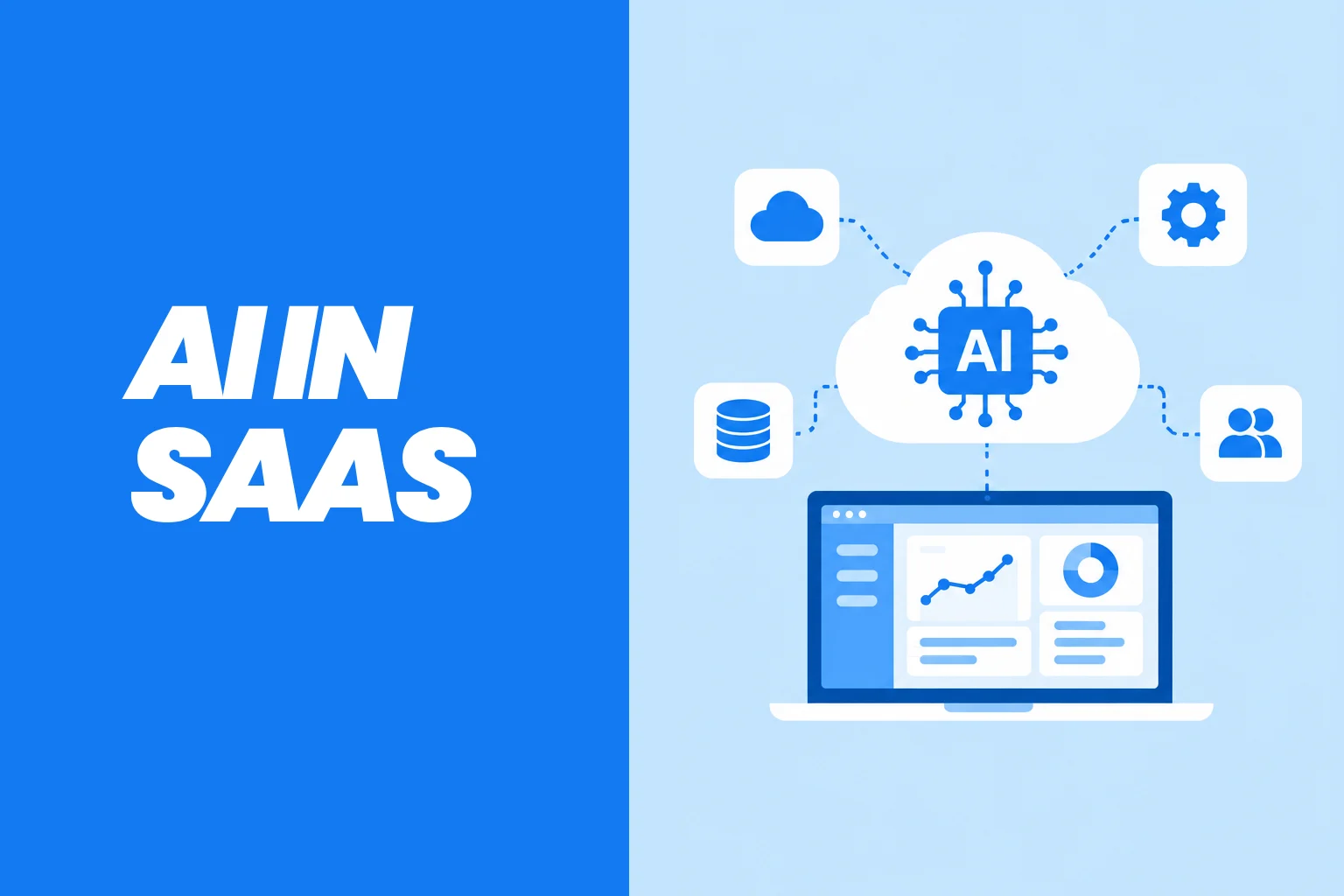
Before exploring AI-enabled SaaS applications, it is important to understand how AI fits into a SaaS environment.
At its core, AI in SaaS brings intelligence directly into cloud-based applications. This allows software to analyze data, identify patterns, generate predictions, automate tasks, and support decision-making with limited manual intervention.
Unlike traditional software that primarily executes predefined rules, AI-enabled SaaS platforms can adapt their behavior based on data, user interactions, and contextual signals.
Every SaaS platform generates large volumes of structured and unstructured data. This can include user interactions, transaction histories, support tickets, customer behavior, product usage patterns, and operational data.
AI systems process this information through data pipelines built on cloud infrastructure and transform it into actionable insights.
Machine learning models can identify patterns within this data, enabling SaaS applications to move beyond static functionality.
For example, a CRM system does more than store customer information. An AI-enabled CRM can analyze historical interactions, identify high-value leads, predict churn risk, and recommend next-best actions to sales and customer success teams.
Several AI technologies support modern SaaS platforms.
Machine Learning (ML): ML algorithms analyze historical and real-time data to identify patterns, forecast outcomes, and support automated decision-making. In SaaS, common applications include churn prediction, recommendation engines, lead scoring, anomaly detection, and dynamic pricing.
Natural Language Processing (NLP): NLP enables software to understand and process human language. It supports chatbots, AI copilots, automated support systems, document processing, and conversational interfaces.
Predictive Analytics: Predictive analytics uses historical and real-time data to estimate future outcomes. SaaS platforms can use it to forecast revenue, anticipate customer behavior, identify churn risk, and detect operational issues.
Generative AI: Generative AI enables SaaS applications to create text, summaries, reports, code, recommendations, and other forms of content. It is increasingly being used in productivity tools, customer support, marketing platforms, and enterprise applications.
AI changes the architecture and behavior of SaaS applications. Traditional systems typically rely on predefined business logic and workflows that require manual updates. AI-enabled systems introduce intelligent components that can analyze changing data and adapt their responses.
This creates a transformation across three major layers:
In advanced implementations, AI agents can reduce the need for users to interact directly with traditional interfaces by executing tasks across connected systems.
For example, an AI agent can analyze a sales call, extract relevant customer information, and update CRM records automatically. This allows the SaaS platform to become more proactive and workflow-oriented.
One of the most important changes introduced by AI is the movement from reactive software toward proactive systems.
Traditional SaaS applications generally wait for users to initiate actions. AI-powered SaaS applications can identify events, make recommendations, trigger workflows, and perform certain tasks automatically.
Examples include automated customer outreach, intelligent workflow execution, anomaly detection, automated reporting, and AI-assisted decision-making.
One of the most important developments in SaaS is the emergence of AI agents.
Unlike traditional automation tools that follow predefined workflows, AI agents can interpret context, make decisions, use connected tools, and execute multi-step tasks with limited human intervention.
Instead of requiring users to navigate dashboards, enter information, and manually trigger workflows, AI agents can handle parts of an end-to-end process.
For example, a sales call can be transcribed, analyzed, summarized, and converted into CRM updates. Similarly, customer support systems can classify requests, retrieve relevant information, draft responses, and escalate complex issues to human agents.
The impact becomes greater when AI agents interact across multiple business systems.
A procurement agent, for example, could retrieve information from an ERP system, check budgets, prepare a purchase order, and coordinate approval workflows across departments.
This evolution is gradually shifting SaaS platforms from passive software interfaces toward intelligent systems that can participate in business processes.
However, autonomous systems also introduce new requirements around trust, security, governance, auditability, and human oversight. Enterprises need appropriate controls to ensure that AI-driven actions remain reliable, explainable, and aligned with business policies.
If SaaS changed how software was distributed, AI is now challenging some of the economic assumptions that helped make SaaS successful.
For years, SaaS growth was closely associated with user growth. More users generally meant more seats and more recurring revenue. AI introduces a different model because software can increasingly perform tasks without requiring a proportional increase in human users.
As AI automates tasks such as data entry, analysis, customer support, and workflow execution, some SaaS categories may face pressure on traditional seat-based pricing models.
This does not mean seat-based pricing will disappear. Instead, SaaS companies may increasingly combine seat-based pricing with usage-based, consumption-based, or outcome-oriented models.
For example, customers may increasingly pay based on:
This represents a broader shift from software being something organizations simply access toward software that actively performs work on their behalf.
For SaaS companies, the challenge will be to align pricing with the value their AI capabilities actually deliver while maintaining predictable and sustainable economics.
The integration of AI into SaaS can deliver benefits across product performance, operational efficiency, customer experience, and business growth.
AI enables SaaS platforms to deliver personalized experiences at scale. Instead of providing identical workflows to every user, systems can adapt recommendations, content, and interactions based on user behavior, preferences, roles, and intent.
For example, AI-powered onboarding can adjust tutorials and feature recommendations according to a user’s role or industry.
Personalization can also extend to email campaigns, in-app messaging, product recommendations, and customer support.
This can improve engagement, reduce friction, and help users reach value faster.
One of AI’s most immediate benefits is the automation of repetitive tasks.
SaaS platforms can use AI to support activities such as support ticket classification, data entry, document processing, workflow approvals, reporting, and anomaly detection.
This reduces manual effort and allows employees to focus on higher-value activities such as product innovation, customer success, research, and strategic decision-making.
For enterprises, this can contribute to faster response times, improved process consistency, and reduced operational overhead.
AI transforms SaaS platforms into more intelligent decision-support systems.
Predictive models can identify churn risks, forecast revenue trends, identify upsell opportunities, and highlight operational anomalies.
For example, customer success teams can prioritize accounts based on churn probability, while sales teams can focus on leads with stronger conversion signals.
This moves organizations from reactive reporting toward more proactive decision-making.
AI creates opportunities for SaaS companies to develop new monetization strategies.
In addition to traditional subscription pricing, businesses can explore usage-based, consumption-based, outcome-based, and hybrid pricing models.
This allows SaaS providers to align pricing more closely with the value delivered to customers.
AI can also create opportunities for new premium features, intelligent assistants, automation capabilities, and specialized AI services.
AI can strengthen security within SaaS environments by identifying unusual behavior, detecting potential fraud, monitoring system activity, and supporting threat detection.
Machine learning models can analyze large volumes of activity data and identify deviations that may indicate suspicious behavior.
When combined with appropriate security controls and human oversight, AI can help organizations improve threat detection and reduce response times.
AI can also improve how SaaS products are designed, developed, tested, and maintained.
AI-assisted development tools can support code generation, documentation, testing, debugging, requirements analysis, and product research.
For SaaS businesses, this can shorten development cycles and help teams experiment with new features more efficiently.
The result is not simply a more intelligent product. AI can also contribute to a faster product development lifecycle.
AI is now being integrated across a wide range of SaaS categories, from customer support and CRM to analytics, marketing, and enterprise operations.
AI-powered chatbots and virtual assistants can handle customer queries around the clock and reduce the workload on human support teams.
NLP allows these systems to understand customer intent and provide contextual responses.
Advanced systems can also analyze sentiment, classify support requests, retrieve relevant knowledge, and escalate complex issues to human agents.
In CRM platforms, AI can improve lead scoring, pipeline forecasting, customer segmentation, and sales recommendations.
Sales teams can receive data-driven recommendations about which leads to prioritize, when to engage customers, and which opportunities may require attention.
This can help improve sales efficiency and reduce time spent on low-probability opportunities.
AI enables more targeted marketing by analyzing customer behavior across multiple touchpoints.
Campaigns can be optimized based on engagement patterns, customer segments, and predicted intent.
Generative AI can also assist with creating emails, advertisements, product descriptions, social media content, and landing page variations tailored to specific audiences.
SaaS companies can use AI to analyze user journeys, identify friction points, understand feature adoption, and improve product experiences.
Behavioral clustering, event analysis, session data, and predictive models can help product teams understand how customers interact with their software.
These insights can support better product decisions and contribute to stronger retention.
AI is increasingly being used to automate routine enterprise workflows.
Examples include invoice processing, HR onboarding, IT service management, document processing, compliance workflows, and internal knowledge management.
AI-powered systems can reduce manual intervention and improve consistency across large organizations.
AI is also enabling specialized SaaS solutions for different industries.
Examples include:
These applications demonstrate how AI can transform general-purpose SaaS products into more specialized and intelligent platforms.
AI is reshaping SaaS at a structural level, but adoption is not without challenges.
Organizations need to address technical, operational, financial, and governance considerations before deploying AI at scale.
1. Cost and Infrastructure Complexity
AI systems can be computationally intensive, particularly during training and real-time inference.
For SaaS providers, this can create additional pressure on infrastructure costs and margins. Scaling AI features across large user bases requires efficient model serving, optimized infrastructure, appropriate model selection, and careful cost management.
2. Data Privacy and Compliance Risks
AI systems often depend on large volumes of data, making privacy and compliance critical considerations.
SaaS organizations need to address requirements related to frameworks and regulations such as GDPR and HIPAA, along with security standards such as SOC 2 where applicable.
Key risks include unauthorized data exposure, insufficient consent controls, inappropriate data retention, and cross-border data handling.
Strong governance and secure architecture are essential for responsible AI adoption.
3. Data Quality and Governance Issues
AI output is heavily influenced by the quality of the underlying data.
Incomplete, inconsistent, outdated, or biased datasets can result in unreliable predictions and recommendations.
Organizations need processes for data validation, quality monitoring, lineage, access control, and governance to maintain trustworthy AI systems.
4. Model Reliability and Bias
AI systems can reproduce or amplify patterns and biases present in their training data.
In applications such as lead scoring, recommendations, hiring, or customer segmentation, biased outputs can create operational and reputational risks.
Continuous monitoring, appropriate evaluation datasets, testing, and human oversight can help organizations identify and address these issues.
5. Integration with Legacy Systems
Many organizations operate legacy systems that were not designed for modern AI workloads.
These environments may lack flexible APIs, real-time processing capabilities, or modern data pipelines.
As a result, AI integration may require API modernization, data integration, phased re-architecture, or gradual migration strategies.
6. Talent and Resource Constraints
AI adoption requires expertise across areas such as machine learning, data engineering, cloud infrastructure, AI engineering, and MLOps.
Organizations may face challenges in hiring and retaining specialized talent.
They also need internal capabilities to monitor, maintain, evaluate, and continuously improve production AI systems.
7. AI Integration and Production Readiness
Moving an AI feature from prototype to production involves more than selecting a model.
Businesses need to consider model evaluation, RAG architecture where applicable, API integration, latency, observability, security, scalability, model monitoring, and inference costs.
A successful proof of concept does not automatically translate into a reliable production system.
8. Market Disruption and Business Model Pressure
AI-native companies are introducing new products with intelligent capabilities built into their architecture from the beginning.
Traditional SaaS companies therefore need to reconsider product architecture, pricing, user experience, and value delivery.
The competitive advantage will increasingly depend on how effectively companies integrate AI into their products rather than simply adding AI as an isolated feature.
Despite these challenges, AI in SaaS is moving toward greater automation, intelligence, and autonomy.
The next phase will not be limited to adding AI features. It will increasingly involve AI becoming part of the core architecture and operating model of SaaS products.
AI agents are expected to play a larger role in SaaS applications.
Instead of simply responding to queries, agents can increasingly plan tasks, interact with tools, retrieve information, and execute multi-step workflows.
This can enable SaaS platforms to become active participants in business processes rather than passive software tools.
Generative AI is becoming an important capability across SaaS products.
It can support automated content creation, code generation, documentation, summarization, customer communication, knowledge retrieval, and intelligent assistance.
Over time, generative AI is likely to become embedded directly into product workflows rather than existing only as a separate feature.
The convergence of AI and IoT can enable real-time, context-aware SaaS applications.
Examples include predictive maintenance, intelligent logistics, supply chain optimization, connected healthcare applications, and industrial monitoring.
AI can increasingly process data closer to where it is generated, supporting faster decisions and more specialized applications.
AI is also reshaping SaaS monetization strategies.
Traditional seat-based pricing may increasingly be complemented by usage-based, consumption-based, or outcome-oriented models.
The right approach will depend on the type of product, customer behavior, AI infrastructure costs, and the value generated by the application.
Organizations are increasingly exploring private, customized, and domain-specific AI architectures to gain greater control over their data and AI behavior.
Rather than building foundation models from scratch, many businesses can leverage existing models and build proprietary application layers, retrieval systems, fine-tuned models, or domain-specific AI solutions around their own data.
This approach can provide greater customization while helping organizations address security, privacy, and governance requirements.
As AI becomes more involved in business decisions, transparency and responsible AI practices will become increasingly important.
Organizations need to understand how AI-generated recommendations and decisions are produced, particularly in sensitive use cases.
Responsible AI frameworks, model monitoring, evaluation, security controls, and human oversight can help organizations build trustworthy AI-powered SaaS products.
As AI reshapes SaaS architecture and economics, its impact extends beyond engineering teams.
Enterprises and product leaders need to rethink how they evaluate, design, and invest in SaaS products.
Traditional metrics such as user growth, subscription revenue, and feature adoption remain important, but businesses are also beginning to consider how much operational value software can generate through automation and intelligent decision-making.
This changes software procurement as well. Enterprises are increasingly interested in whether a platform can reduce operational effort, improve decision-making, and deliver measurable business outcomes.
For product leaders, this creates a different design philosophy. Instead of continuously adding features, teams can focus on building adaptive workflows that use AI to simplify complex tasks.
AI can become part of multiple product layers, from onboarding and customer support to analytics, recommendations, and workflow execution.
Competitive differentiation is also changing.
SaaS competition has historically been driven by features, usability, integrations, and pricing. AI adds another layer of differentiation through model performance, proprietary data, AI architecture, automation capabilities, and the quality of intelligent experiences.
For SaaS businesses, treating AI as a small add-on may not be enough in markets where competitors are building AI into their products from the ground up.
Ultimately, enterprises are moving toward software that does more than provide functionality. They are increasingly looking for intelligent systems that can help them analyze information, automate work, and support better decisions.
AI is no longer simply enhancing SaaS platforms. It is changing how SaaS products operate, deliver value, and scale.
From intelligent automation and predictive analytics to generative AI and autonomous agents, AI is pushing SaaS beyond traditional software models toward more adaptive and outcome-oriented systems.
For businesses, this transformation creates opportunities to improve operational efficiency, personalize customer experiences, automate workflows, and develop new software products.
However, realizing these benefits requires more than adding an AI feature. Businesses need the right architecture, data strategy, security controls, governance framework, and implementation approach to build AI systems that are reliable, scalable, and ready for production.
At Alcax, we help businesses design, develop, and integrate AI-powered SaaS solutions by combining AI engineering, cloud architecture, data infrastructure, and software product development expertise. Whether the goal is to integrate generative AI into an existing SaaS platform, automate complex workflows, or build an AI-native product from the ground up, Alcax helps turn AI concepts into scalable, production-ready solutions designed around real business needs.
Considering developing an AI-powered SaaS product? Connect with Alcax’s AI experts to build a scalable, secure, and tailored SaaS solution designed around your business needs. Explore our AI development services to turn your AI SaaS idea into a production-ready product.
AI in SaaS refers to integrating artificial intelligence technologies into cloud-based software to automate tasks, analyze data, personalize user experiences, and deliver intelligent features.
AI can improve SaaS applications through automation, predictive analytics, intelligent recommendations, natural language interactions, personalization, and faster decision-making.
Common applications include AI-powered customer support, predictive analytics, recommendation engines, fraud detection, personalization, intelligent search, content generation, and workflow automation.
Key benefits include improved operational efficiency, enhanced customer experiences, better decision-making, workflow automation, personalized services, and faster product innovation.
SaaS products commonly use machine learning, generative AI, natural language processing, computer vision, predictive analytics, recommendation systems, and AI agents.
Major challenges include data privacy and security, integration with existing systems, data quality, AI infrastructure costs, model reliability, compliance, and production readiness.
The cost depends on factors such as product complexity, AI capabilities, integrations, data requirements, infrastructure, security needs, and development time. A simple AI feature will generally require less investment than a fully AI-native SaaS platform.
Not necessarily. AI should be implemented where it solves a clear business or user problem, improves efficiency, or creates measurable product value rather than being added simply as a feature.