Oct 15, 2026 Artificial Intelligence
AI in Fraud Detection: Use Cases, Architecture, Benefits, and Implementation
Oct 15, 2026 Artificial Intelligence

Table of Contents
Oct 15, 2026 Artificial Intelligence / Alcax
Every second, millions of payments, logins and claims move across digital channels. Each one is a chance for a fraudster to slip through. As businesses move more of their operations online, the attack surface keeps growing, and so does the bill.
In 2025, US consumers filed 3 million fraud reports with the Federal Trade Commission and reported $15.9 billion in losses, up from just over $12 billion a year earlier. Investment scams alone accounted for $7.9 billion. And the threat is accelerating: Deloitte’s Center for Financial Services projects that generative AI could push US fraud losses to $40 billion by 2027, growing at roughly 32% a year.
The defense is scaling too. MarketsandMarkets expects the global fraud detection and prevention market to grow from $32 billion in 2025 to $65.68 billion by 2030, with AI and machine learning at the center of that spend.
The reason is simple. Static rules can’t keep up with fraudsters who now use bots, synthetic identities and deepfakes. AI can learn what normal looks like, spot what doesn’t, and adapt as tactics change.
In this guide, we cover how AI fraud detection works, the architecture behind it, the techniques and use cases that matter, and how to implement it the right way.
For years, fraud teams relied on fixed rules and thresholds: block any transaction above $5,000 from a new device, flag three failed logins in a row. That worked when fraud was simple and slow. It doesn’t work when attackers run automated bots, test thousands of stolen cards in minutes and change tactics the moment a rule blocks them.
AI changes the model. Instead of waiting for an analyst to write a new rule, machine learning and deep learning models learn directly from historical and live data. They build a picture of what legitimate behavior looks like for each customer, device and merchant, then score every new event against it.
This is not a passing trend. It is a structural shift in how organizations defend themselves. Because the models keep learning, they catch subtle, low-signal fraud that rule engines miss, and they evolve alongside the fraudsters instead of trailing behind them.
Before AI, most organizations depended on two methods: rule-based systems and statistical anomaly detection. Both still have a place, but on their own they struggle against modern fraud.
| Approach | How it works | Strengths | Weaknesses |
|---|---|---|---|
| Rule-based systems | Experts write if-then rules based on known fraud patterns, such as amount limits, velocity checks and blocked geographies. | Fast, transparent and easy to audit for well-known fraud scenarios. | Misses new schemes, needs constant manual updates, generates many false positives and has no sense of context. |
| Statistical anomaly detection | Flags data points that sit far from the expected range using clustering, z-scores and outlier analysis. | Can surface unknown fraud patterns without labeled data. | Hard to separate real fraud from normal variation, high false positive rates, weak on high-dimensional data. |
These gaps are exactly where AI earns its place, as the next sections show.
Fraud takes many forms, and each leaves a different trail in the data. AI is effective because it can read many of those trails at once. Here are the fraud types AI-powered systems handle well.
Fraudsters rarely test stolen cards by hand. They use bots to run card-testing and brute-force attacks against payment gateways. AI models learn each cardholder’s normal spending, merchants, amounts and locations, then flag transactions that break the pattern, such as a burst of small test charges or a purchase in a city the customer has never visited.
In an account takeover, a criminal gains access to a real user’s account through phishing, credential stuffing or leaked passwords. AI watches for sudden changes in login location, device, typing speed or navigation patterns. Combined with step-up authentication, it can stop the attacker before money or data leaves the account.
AI checks identity signals together: device fingerprints, geolocation, biometrics, personal details and transaction history. An unexpected address change followed by a new card request and a large transfer is the kind of sequence a model will catch and route for review.
Synthetic identities mix real data, such as a valid Social Security number, with invented names and addresses. They often build credit quietly for months before “busting out.” AI spots the inconsistencies and linked attributes that reveal these fabricated profiles.
AI reviews medical claims and provider billing to find overbilling, phantom billing, upcoding and unnecessary procedures. It also flags patients or providers who submit false information to obtain services or payments.
Models compare each claim with historical claims and known fraud signals. Frequent or unusually large claims, staged accidents, and mismatches between reported details and supporting evidence all raise the risk score.
Online retailers face stolen card use, fake accounts, promo abuse and return fraud. AI analyzes browsing behavior, order history and checkout signals to separate genuine shoppers from bad actors without adding friction for good customers.
When someone applies for a loan, credit card or account with false or stolen details, AI cross-checks the application against historical and third-party data. Inconsistent details, reused contact information or links to known fraud rings trigger a review.
AI looks for patterns typical of laundering: structured deposits just under reporting limits, rapid movement between accounts, and unusual routing through high-risk jurisdictions. It helps compliance teams focus on the cases that matter instead of sorting through thousands of low-quality alerts.
Money mules, sometimes unwitting, move illicit funds for criminals. Behavioral analytics and network analysis help AI spot accounts that suddenly receive and forward funds, often across borders, and map the wider network behind them.
Natural language models analyze email content, sender reputation, links and landing pages to catch phishing attempts before users click. They learn the language patterns and lures attackers use, even as those messages get more polished.
Computer vision and optical character recognition (OCR) check IDs, bank statements and invoices for altered fonts, inconsistent layouts, tampered images and mismatched data. This stops forged documents at onboarding and claims intake.
Criminals now use AI-generated voice and video to impersonate executives, customers and family members. Detection models look for visual and audio artifacts, such as lip-sync errors, unnatural lighting and voice anomalies, and pair this with liveness checks and biometric verification.
Across every category, the advantage is the same. AI analyzes large volumes of data, learns from new cases and adapts to new tactics, giving businesses a proactive defense instead of a reactive one.
A modern AI fraud detection system combines classic machine learning scoring with large language models (LLMs) connected to the organization’s own data. The ML layer scores events in real time; the LLM layer helps analysts investigate, explain and act on what the models find. Here is how the pieces fit together.
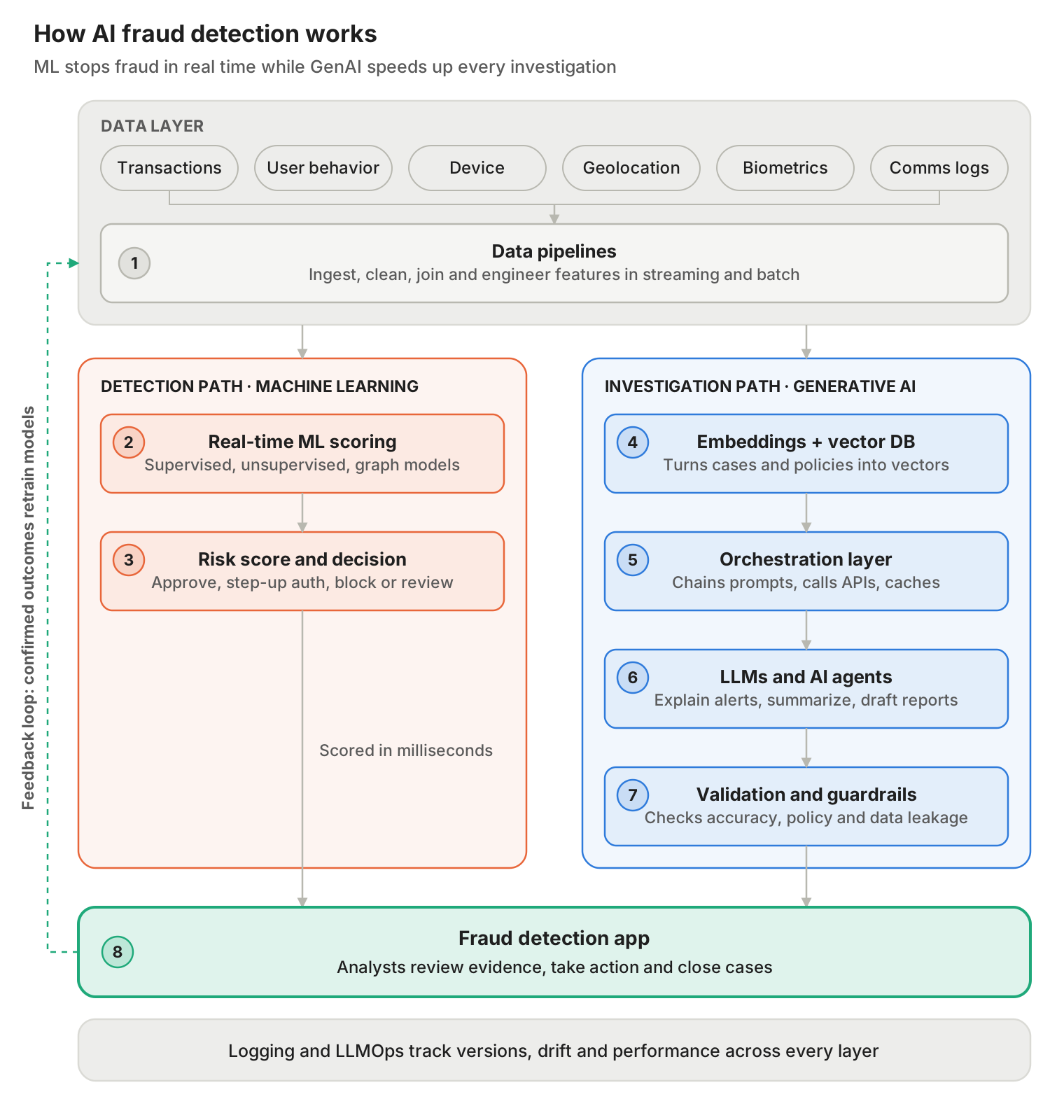
The left path scores every event in real time; the right path gives analysts AI-generated context. Both meet in the fraud detection app, and confirmed outcomes feed back into training.
1. Data sources. Everything starts with data relevant to fraud:
2. Data pipelines. Streaming and batch pipelines ingest the raw data, clean it, join it, and turn it into features such as “transactions in the last 10 minutes” or “distance from last login.”
3. Real-time ML scoring. Supervised and unsupervised models score each transaction or login within milliseconds and return a risk score. High scores can block, step up authentication or send the event to review.
4. Embedding model. Unstructured data, such as case notes, policies, emails and claim descriptions, is split into chunks and converted into vectors by an embedding model so the AI can search and compare it by meaning.
5. Vector database. The embeddings live in a vector database (for example Pinecone, Weaviate or pgvector), which makes it fast to retrieve similar past cases, relevant policies or related customer history.
6. APIs and plugins. Connectors link the system to core banking, payment processors, KYC providers, sanctions lists, CRM and ticketing tools so the AI can pull extra context or trigger actions.
7. Orchestration layer. This is the conductor. Frameworks such as LangChain or LlamaIndex chain prompts together, decide when to call external APIs, fetch context from the vector database and keep memory across steps.
8. Query execution. An analyst or an automated workflow asks a question, such as “Why was this account flagged, and is it linked to other cases?”
9. LLM processing. The orchestration layer gathers the relevant scores, records and retrieved context and sends them to the most suitable LLM.
10. Output. The model returns an alert summary, an investigation report, a risk explanation or a recommended action, such as holding a payout or requesting more documents.
11. Fraud detection app. Results appear in the analyst’s dashboard or case management tool, where people review the evidence and make the final call.
12. Feedback loop. Every confirmed fraud case and every false positive feeds back into training data, so both the ML models and the prompts get sharper over time.
13. AI agents. For multi-step work, AI agents plan tasks, use tools, check their own results and hand off to humans when confidence is low.
14. LLM cache. Frequent queries and responses are cached with tools like Redis or GPTCache to cut latency and cost.
15. Logging and LLMOps. Tools such as MLflow, Weights & Biases or Helicone track model versions, prompts, drift and performance, which is essential for audits.
16. Validation and guardrails. A validation layer checks outputs for accuracy, policy compliance and data leakage before anything reaches a user or triggers an action.
17. LLM APIs and hosting. Teams choose between commercial LLM APIs (such as OpenAI, Anthropic or Google) and open-source models, hosted on AWS, Azure, Google Cloud or platforms like Databricks, depending on data residency, cost and compliance needs.
Together, these layers let the system catch fraud in real time, explain why it acted, and help investigators close cases faster.
AI fraud detection is not limited to banks. Any business that moves money, verifies identities or pays claims can use it. Here is how different industries apply it.
The common thread is the same: AI reads data at a scale and speed people can’t, and it gets better with every case it sees.
Fraudsters are using generative AI to scale their attacks. Defenders can use the same technology to fight back. Here is where GenAI adds the most value.
Generative models trained on genuine IDs, statements and invoices learn their fine details. They highlight layout, font and image inconsistencies that point to forged or AI-generated documents during onboarding and claims.
Models learn the characteristics of real human speech and of known customers’ voices. They help contact centers and voice-authentication systems detect cloned or synthetic voices before an impersonator gets access.
Trained on large volumes of transaction behavior, generative models learn the full distribution of normal activity. Transactions that are unlikely under that distribution are flagged for review.
Real fraud is rare, which makes training data unbalanced. GenAI can create realistic synthetic fraud scenarios, so models learn from more examples without exposing real customer data. It can also simulate new attack patterns before they appear in the wild.
LLMs can summarize and interpret behavioral signals, such as login frequency, session timing and how users interact with banking apps, giving analysts a plain-language view of why a session looks risky.
GenAI understands how legitimate communication usually reads. It catches messages that use unusual urgency, mimic a brand or executive, or push users toward risky actions.
LLM-powered copilots summarize case files, pull related alerts, draft suspicious activity report (SAR) narratives and answer analysts’ questions in plain English, cutting investigation time.
Used well, GenAI makes fraud programs faster and more adaptive. It works best alongside proven ML scoring and human review, not as a replacement for them.
Generative AI doesn’t just detect fraud. It speeds up every stage of the investigation that follows. Here is how it supports a typical fraud workflow from first alert to case closure.
| Stage | What happens | How GenAI helps |
|---|---|---|
| 1. Capture data | The system flags suspicious activity through rules or models and collects transaction, customer and device data. | Real-time anomaly detection across live transaction streams. Data enrichment that pulls extra context such as IP intelligence, device reputation and watchlist hits. |
| 2. Assess and triage | Analysts check customer history, decide if the alert needs investigation and assign it. | Risk scoring that combines model outputs with customer history. Case summaries that let analysts triage in seconds. Smart routing that sends each case to the right specialist team. |
| 3. Investigate | Analysts review transactions, behavior, account history and linked activity, and may contact the customer. | Link analysis that maps connections between accounts, devices and payees. Anomaly explanations in plain language. Suggested interview questions based on case details. Document summaries of long logs and transcripts. |
| 4. Mitigate risk | The team decides on action: block, hold, restrict or release, and notifies the customer if needed. | Action recommendations based on similar past cases and internal policy. Automated triggers for high-confidence fraud. Collaboration support across fraud, compliance and management. Personalized customer messages that explain the action. |
| 5. Resolve | The team confirms the outcome, documents findings and closes the case. | Outcome prediction with supporting evidence. Auto-drafted case reports and SAR narratives. Continuous learning as confirmed outcomes flow back into model training. |
The result is fewer hours lost to manual review and faster, more consistent decisions. Human judgment still matters most for edge cases, customer impact and regulatory decisions.
There is no single “fraud algorithm.” Effective systems combine several techniques, each suited to a different kind of data or threat.
The right mix depends on your data, fraud types, latency needs and regulatory constraints. Most mature programs layer several of these techniques together.
Fraud is no longer an occasional cost of doing business. FTC data show that reported US consumer fraud losses rose in each of the past six years, and approximately half of 2025’s losses came from investment scams. Strong fraud detection protects far more than the balance sheet.
AI makes fraud programs more accurate, faster and cheaper to run. Here are the benefits businesses see most often.
At Alcax, we design and build custom AI fraud detection systems that fit your data, your risk appetite and your existing technology stack. Our AI development services cover the full lifecycle, from strategy to production.
We also build AI agents and copilots that take repetitive work off your analysts and speed up decisions.
The goal is simple: catch more fraud, approve more good customers and give your team the tools to move faster.
AI can transform a fraud program, but only if it is implemented with care. These practices separate successful projects from stalled pilots.
Fraud and fraud prevention are evolving together. These are the trends shaping the next few years.
Fraud is growing faster and getting smarter, powered by bots, synthetic identities and generative AI. Static rules alone can’t keep up. AI gives businesses a way to fight back: it detects fraud in real time, adapts as tactics change and gives investigators the context they need to act fast.
The organizations that win will treat AI fraud detection as a living system. They will invest in clean data, the right mix of models, strong governance and people who know how to use the insights. Those that wait will keep paying for fraud in losses, chargebacks and lost customer trust.
The path forward is clear: stay current on emerging threats, put AI to work where it delivers the most value, and build a fraud program that protects both your business and your customers.
Ready to strengthen your fraud defenses? Talk to Alcax’s AI experts to build a custom AI fraud detection solution that fits your business.
AI in fraud detection is the use of machine learning, deep learning and generative AI to identify suspicious transactions, logins, applications and claims. Instead of relying only on fixed rules, AI learns normal behavior from data and flags activity that deviates from it.
Machine learning models are trained on historical data that includes both legitimate and fraudulent activity. They learn the patterns that separate the two and assign each new event a risk score. High-risk events can be blocked, challenged with extra authentication or sent to an analyst.
Yes. Because AI considers many signals together and understands each customer’s normal behavior, it can approve more legitimate transactions that rigid rules would wrongly decline, while still catching real fraud.
Generative AI creates synthetic fraud data for training, detects forged documents and cloned voices, flags phishing messages and powers investigation copilots that summarize cases and draft reports.