Sep 9, 2026 Artificial Intelligence
AI in Banking and Finance: Use Cases, Benefits, Challenges and Future
Sep 9, 2026 Artificial Intelligence

Table of Contents
Sep 9, 2026 Artificial Intelligence / Alcax
A fraud team that once reviewed flagged transactions the next morning now scores them in the milliseconds between a card swipe and an authorization decision, using a model trained on years of transaction history instead of a fixed rule set. That shift, from after-the-fact review to real-time decisioning, is a fair summary of what AI has actually changed in banking: specific, well-bounded decisions inside specific workflows getting faster, more consistent and, in many cases, more accurate. This article covers where AI genuinely earns its place in banking and finance today, the benefits that hold up under scrutiny, the risks that come with them, and what a realistic implementation path looks like.
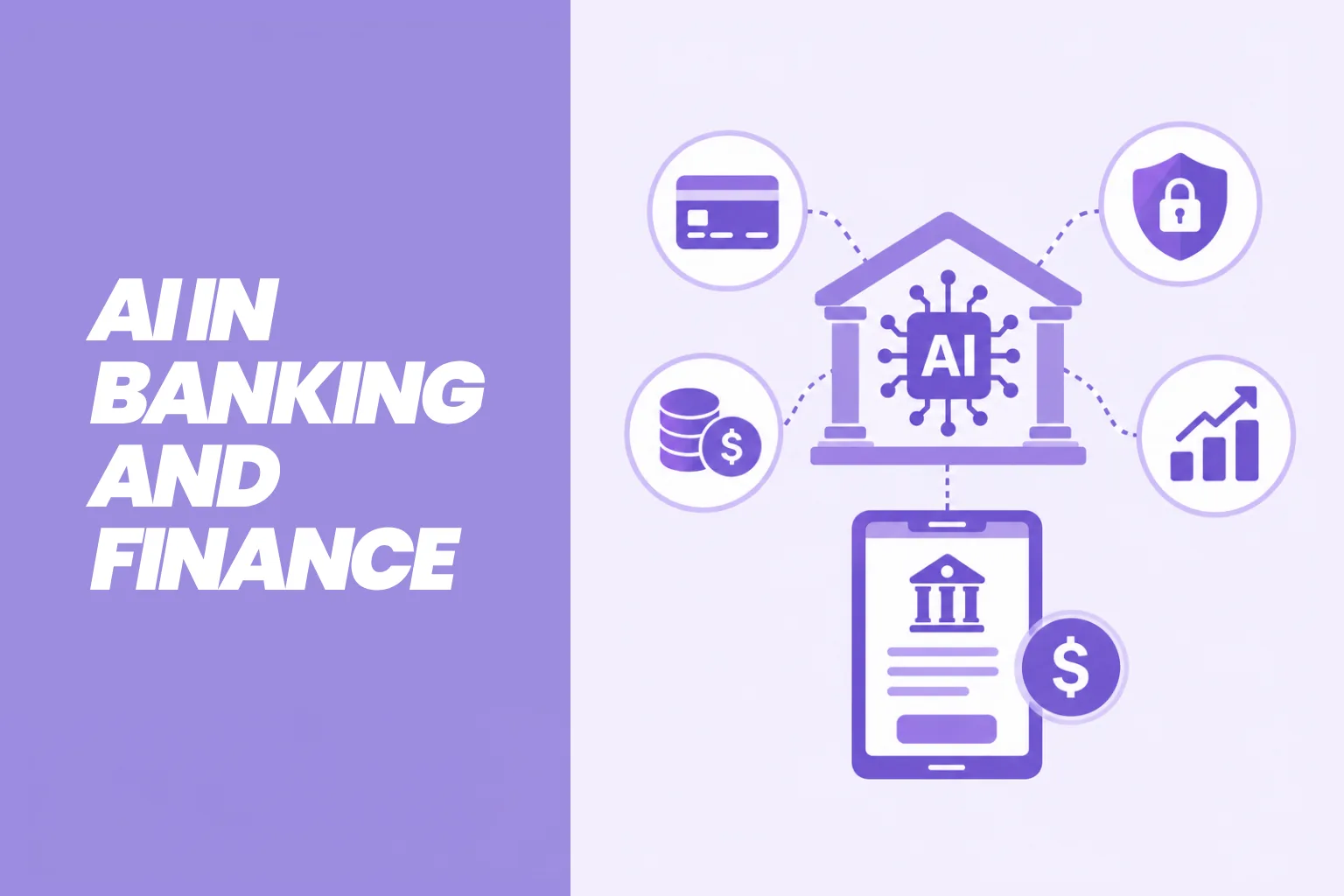
AI in banking and finance is the use of machine learning, NLP, computer vision, and generative AI to automate or improve decisions across lending, payments, risk, compliance, and customer service. It isn’t one technology: a fraud model, a chatbot and a ledger-reconciling agent work in fundamentally different ways.
The Bank for International Settlements notes that institutions currently deploy AI mostly to strengthen internal operations and compliance rather than generate revenue directly, with generative AI adoption still cautious compared with established machine learning. Most of what counts as “AI in banking” today is quieter than the agentic-banking headlines suggest.
Manual review, static rules and legacy risk models no longer hold up against the volume and sophistication of modern financial activity.
Fraud has gotten faster and more automated, with criminal networks using automation and increasingly generative tools, to create synthetic identities and convincing phishing. A bank running fixed rules is structurally behind a model that learns from behavioral patterns.
Customer expectations moved first elsewhere. McKinsey found generative AI adoption among US working-age adults reached 45 percent by 2024 and 55 percent by 2025, a penetration rate that took digital banking roughly 15 years to reach.
Leaner competitors are squeezing margins: leading neobanks post 30 to 35 percent return on equity, challenging the old assumption that growth and profitability trade off in banking.
Compliance workloads keep growing faster than headcount, making AI-assisted document review and alert triage less about innovation and more about keeping operations solvent.
Most AI systems follow the same pattern: data goes in, a model processes it against learned patterns, and an output (a score, a document, a recommended action) comes out, usually with a human able to intervene somewhere in the flow.
A fraud model trains on historical transactions and scores new ones against behavioral patterns; a generative system drafting a credit memo instead retrieves statements and policy documents, often through retrieval-augmented generation (RAG), grounding it in verified data, then produces a draft a human edits; an agent chains such steps together, pulling documents, checking policy, and escalating exceptions it isn’t authorized to resolve. What ties all three together is data quality: a model is only as reliable as what trained it.
Machine learning models score transactions against behavioral, device, and network signals in real time, catching patterns static rules miss, such as spending that matches a known fraud ring across merchants that individually look unremarkable. The same approach extends to the full transaction stream, flagging structuring or unusual velocity while a hold is still possible. The value is a lower false-positive rate than legacy rules: every false decline blocks a real purchase, and every missed case is a direct loss.
AI-based scoring incorporates a wider set of signals than bureau data alone, including cash-flow patterns, producing a more useful picture for thin-file applicants who’d otherwise score poorly by default. During underwriting, AI extracts data from applications, flags missing evidence, and prepares a case for review, cutting file-assembly time from hours to minutes while the decision, and accountability for it, stays with a person. Explainability is the real constraint: a bank must show why a decision was made, which is why credit scoring is classified as high-risk under the EU AI Act.
AI applied to onboarding extracts data from identity documents, runs consistency checks, and cross-references watchlists, cutting onboarding time from days to minutes for routine cases; complex cases such as politically exposed persons still route to a compliance analyst. On the AML side, alert systems historically generate large volumes of false positives; models that learn from investigator decisions re-rank alerts so genuine suspicious activity surfaces first, changing what analysts spend limited review time on.
Conversational AI handles routine queries (balances, disputes, card replacement) using generative AI rather than scripted trees, so it handles varied phrasing; the realistic scope is tier-one support, with hardship cases still escalating to a person. The same underlying data powers personalization, surfacing relevant recommendations or flagging a forgotten subscription, and feeds churn prediction: identifying customers showing early attrition signs so retention teams can intervene while there’s still a relationship to save.
Robo-advisory platforms build and rebalance portfolios algorithmically based on a client’s risk tolerance and goals, typically at lower cost than a human advisor for standard portfolios, with generative AI now layering on top to explain decisions in plain language and draft client updates. Complex planning, estate planning, tax strategy, and major life transitions still benefit from human advisory judgment.
Quantitative desks have used statistical models for decades; what’s changed is machine learning processing alternative data (news sentiment, supply-chain signals) alongside price and volume, and generative AI summarizing research and earnings calls faster than manual review. This stays among the most rigorously tested use cases, given the direct link between model behavior and market risk.
Beyond credit risk, AI supports market, liquidity, and operational risk by spotting patterns across large datasets, such as early counterparty-stress indicators that wouldn’t show up in standard reporting, and improves cash-flow forecasting by incorporating more variables than traditional models. The Federal Reserve’s Vice Chair for Supervision has framed AI as a potential “force multiplier” for risk functions, while stressing that supervisory guidance must evolve alongside it.
AI automates regulatory reporting by extracting data points from source systems and flagging inconsistencies before submission, while generative AI drafts narrative sections and summarizes new regulatory text against policy. The same capability (computer vision to read a document, NLP to extract fields) underpins contract analysis, flagging non-standard clauses for lawyer review, and turns pay stubs and statements into usable data without manual re-keying.
AI matches invoices to purchase orders and receipts, reconciles transactions across systems, and flags discrepancies for review, a mature enterprise application that delivers real value given banking’s volumes and audit requirements. The same logic applies to collections: ranking delinquent accounts by predicted repayment likelihood and recommending contact channel and timing, while fair-lending and collections rules still apply in full.
AI-driven security tools monitor network traffic, login patterns, and system behavior to catch intrusions and account-takeover attempts that signature-based tools miss, which matters because attackers increasingly use AI to generate convincing phishing themselves. The BIS has flagged AI-enabled fraud, including deepfakes, as a financial-stability risk, not just an IT concern.
Generative AI copilots are embedded into internal tools for relationship managers, underwriters, and compliance analysts, drafting summaries and answering questions against the bank’s own knowledge base through RAG, paired with human review before anything customer-facing goes out. AI agents extend this to multi-step tasks: gathering documents, checking them against policy, and escalating exceptions to a human. Accenture’s 2026 research found 57 percent of banking executives expect AI agents fully embedded in risk, compliance, and fraud within three years, a three-year expectation, not where most banks are today; current deployments stay narrow, with a human able to intervene at every stage.
| Department | AI Applications | Business Value |
|---|---|---|
| Retail Banking | Chatbots, personalization, fraud alerts | Lower service cost, faster resolution |
| Commercial Banking | Cash-flow forecasting, credit scoring | Faster credit decisions |
| Wealth Management | Robo-advisory, rebalancing | Lower-cost advisory at scale |
| Lending and Credit | Automated scoring, underwriting support | Faster approvals, thin-file access |
| Risk and Compliance | AML triage, KYC automation | Fewer false positives, faster onboarding |
| Finance, Operations and Audit | Reconciliation, workflow automation, AI Anomaly detection | Faster close cycles, broader coverage |
Final judgment calls, adverse-action decisions, audit opinions, complex disputes, stay with a person; AI compresses the work leading up to them.
| Capability | Traditional AI/ML | Generative AI | AI Agents |
|---|---|---|---|
| Function | Prediction, classification, scoring | Summarization, drafting, conversation | Planning, tool use, workflow execution |
| Example | Credit scoring, fraud detection | Credit memo drafting, chatbots | Automated loan-file assembly |
| Maturity | Mature, widely deployed | Growing, mostly internal-facing | Early-stage, closely supervised |
| Primary risk | Bias, drift, explainability | Hallucination | Compounding errors, unclear accountability |
Match the approach to the problem: scoring needs traditional ML, drafting needs generative AI, a multi-step workflow needs an agent. None of this makes agents a staff replacement: Accenture found nearly half of banks and insurers surveyed are creating new roles to supervise AI agents, a sign the operating model is shifting toward structured oversight, not headcount elimination.
Data quality and privacy. Most banks run on decades-old legacy systems with inconsistent formats and siloed data, and a model is only as good as the data that trains it. Pulling from multiple sensitive sources also raises real consent and security questions, and makes the AI system itself a new attack surface (model poisoning, prompt injection).
Model risk, explainability and bias. A model that performed well historically can degrade as conditions shift, requiring ongoing monitoring rather than one-time validation. Institutions must also explain credit and lending decisions to regulators and customers, and models trained on historical data can perpetuate discrimination through proxy variables, even in the absence of protected-class fields, necessitating deliberate testing for disparate impact.
Regulatory compliance is a moving target: under the EU AI Act, credit-scoring AI is classified as high-risk, and after the Digital Omnibus agreement, the deadline for these systems moved from August 2026 to December 2, 2027, more time but not less substance.
Legacy infrastructure, built without API-first design, turns AI integration into an engineering project more than a data science one; most projects fail on workflow fit, not model quality. Hallucination compounds this in generative AI: fluent but wrong output is a real problem when a wrong figure lands in a credit memo, which is why RAG, mandatory human review, and a defined owner for every system touching a financial outcome all matter.
| Stage | Sample KPI |
|---|---|
| Data readiness | % of required fields complete and labeled |
| Pilot | Accuracy, false-positive rate, processing-time reduction |
| Scale | Cost per transaction, compliance exception rate |
Machine learning and deep learning power the predictive core (fraud, scoring, risk); NLP and computer vision handle unstructured input like documents and complaints. Large language models underpin drafting and conversation, grounded through retrieval-augmented generation (RAG) in an institution’s own verified data, with vector databases enabling the fast retrieval RAG depends on. APIs connect all of this to core banking and CRM systems, without which even a well-built model stays isolated. Cloud infrastructure (often hybrid, given data sensitivity) supplies computational scale, MLOps keeps models from degrading after launch, and it all sits on a data platform: clean, governed data is the real prerequisite, not model choice.
Financial AI needs stronger controls than consumer AI because decisions affect a person’s access to credit and money. That means explainability and auditability (a documented trail of data, output, and reviewer), data governance and access controls over who can query or retrain a model, independent model validation, real human oversight at defined points, and ongoing bias and drift monitoring against thresholds that trigger review.
Requirements vary by jurisdiction: the UK’s FCA takes a principles-based approach built on existing rules like the Consumer Duty; India’s RBI published a FREE-AI framework in August 2025 with seven principles and 26 recommendations (RBI, via KPMG); and the US Fed, OCC and FDIC have updated model risk guidance for generative and agentic AI specifically. Cross-border institutions should govern to the strictest applicable standard, using a structure like the NIST AI Risk Management Framework (Govern, Map, Measure, Manage) for documentation, even though it remains voluntary.
Already happening: fraud detection, AML triage, document processing, and internal copilots run in live production at scale, moving from pilot to standard tool at many banks.
Emerging: AI agents executing multi-step workflows, such as loan-file assembly with human sign-off, are piloted but remain narrowly scoped. Accenture research suggests most banking executives expect agentic AI embedded across risk, compliance, and lending within roughly three years, with real-time risk intelligence and hyper-personalized banking moving toward early deployment at leading institutions.
Still experimental: fully autonomous workflows without human checkpoints and unsupervised credit decisions above defined risk thresholds aren’t standard practice anywhere serious. Concentrated reliance on a small number of AI providers is a systemic risk the BIS and Financial Stability Board are actively monitoring.
The realistic trajectory is steady expansion within defined boundaries, with human oversight growing more structured, not less, as adoption grows.
There’s no single universal price. Cost depends on use-case complexity (document processing costs far less than a real-time fraud system with strict latency needs), data readiness (cleanup is often the largest line item), model choice (custom builds cost more upfront than API-based models), integration with legacy systems, and regulatory requirements proportional to sensitivity. Ongoing monitoring rounds out total cost of ownership, typically underestimated against the initial build.
As an indicative range only: a narrow, single-use-case pilot often falls in the low hundreds of thousands of dollars, while an enterprise-wide program with deep integration can run into the millions over multiple years. Treat any vendor quote as tied to a specific, documented scope.
AI’s value in banking doesn’t come from pursuing “AI transformation” as a goal. It comes from picking a well-bounded workflow, making sure the underlying data can support the decision, building in a genuine human review point, and measuring the result against a clear baseline before scaling further. Institutions that skip that groundwork tend to hit legacy integration or data-quality problems later, at a costlier stage of the project.
If you’re evaluating where AI fits into your institution’s roadmap, whether that’s a single fraud-detection pilot or a broader agentic workflow strategy, Alcax’s AI development services team works with banks and financial services companies on exactly this kind of build: scoping the right use case, assessing data readiness, and designing AI systems for the governance and audit requirements financial services operates under.
It’s the application of machine learning, NLP, computer vision, and generative AI to automate or improve financial decisions, from fraud detection and credit scoring to customer service and compliance. It spans predictive models, generative drafting tools, and AI agents that run multi-step workflows under human oversight.
AI models score transactions in real time against learned behavioral and device patterns, flagging anomalies that static rules miss, such as spending matching a known fraud ring. This lowers false positives versus fixed rules while catching fraud that evolves faster than manual updates can track.
It drafts credit memos and regulatory filings, summarizes research and communications, powers more natural chatbots, and answers employee questions grounded in a bank’s own policy documents through retrieval-augmented generation, largely within internal, human-reviewed workflows rather than autonomous customer-facing use.
The biggest are data quality and legacy infrastructure, explainability for regulated decisions, model bias and drift, evolving regulation across jurisdictions, and the change management needed to build trust in AI-assisted decisions. Integration usually proves harder than the modeling itself.
Most successfully by starting with a specific, lower-risk use case, assessing data readiness before building, running a controlled pilot with defined metrics, keeping a real human review point for consequential decisions, and following recognized AI frameworks like the NIST AI Risk Management Framework for governance.